Two English Department Scholars Named 2025–2026 Morgridge Fellows
Scholarship meets real-world impact through the work of two Morgridge Fellows.
by Fabiola M. Martinez Del Valle
The English Department is proud to recognize Assistant Professor Kirk Sides and PhD candidate Nicole Ramer as members of the 2025–2026 Morgridge Fellows cohort. They join a university-wide learning community dedicated to advancing community-engaged scholarship. Through monthly seminars and cohort-based collaboration, fellows explore how research and teaching can be more deeply rooted in reciprocal partnerships with local and global communities.

Kirk Sides, who holds a joint appointment in English and African Cultural Studies, brings a globally engaged lens to the fellowship. His forthcoming book, Environmental Entanglements: African Literature’s Ecological Imaginary (Oxford UP), traces a century of ecological thought in African literature. As part of the fellowship, Sides is shifting toward a more community-based model of research. His next project, Narrative on the Edge: Storytelling and Environment, will collaborate with artists, literary practitioners, and festival organizers in Botswana to explore how environmental change is imagined and narrated in local communities.
“I am still primarily concerned with stories and the environments,” Sides says. “What has changed is how I will collect these stories. I want to talk to people. I want to engage with communities, through workshops, through the co-production of creative material such as anthologies and exhibitions, especially in communities acutely affected by environmental and climate change.”
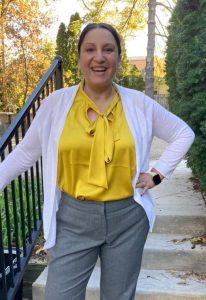
Nicole Ramer, a PhD candidate in composition and rhetoric, focuses on digital community writing and health discourse. Her dissertation examines Facebook cancer support groups as spaces where women exercise agency and reshape public narratives around illness. Grounded in partnerships with group facilitators, her work highlights how digital platforms sustain meaningful community engagement. In the classroom, Ramer emphasizes community knowledge as a rigorous form of research, encouraging students to engage with local expertise and lived experience.
Both scholars exemplify the department’s commitment to socially engaged scholarship and bring distinct, justice-oriented lenses to their work. Their selection as Morgridge Fellows reflects not only their individual achievements but also the growing role of community engagement in the humanities.