Exploring the UW Madison English Graduate Experience
A deeper look into the ways in which UW English Graduate Programs have been valuable for the students.
by Reilly White
Amongst its many well-known gems, UW Madison is especially notable for its English graduate programs. Whether one is interested in pursuing a master’s degree or a PhD, the university offers several distinct tracks that appeal to a significant range of English scholarship. The degrees offered are a Master of Fine Arts in Creative Writing, A Master’s degree in Applied English Linguistics, a PhD degree in English: Literary Studies, English: Composition and Rhetoric, and English: English Language and Linguistics. Additionally, the university offers a unique African American Studies Bridge Program, in which an English PhD and an African American Studies Master’s degree can be pursued at the same time. On top of that, many graduate students take on the Teaching English as a Second Language (TESOL) certificate, also offered by the university.
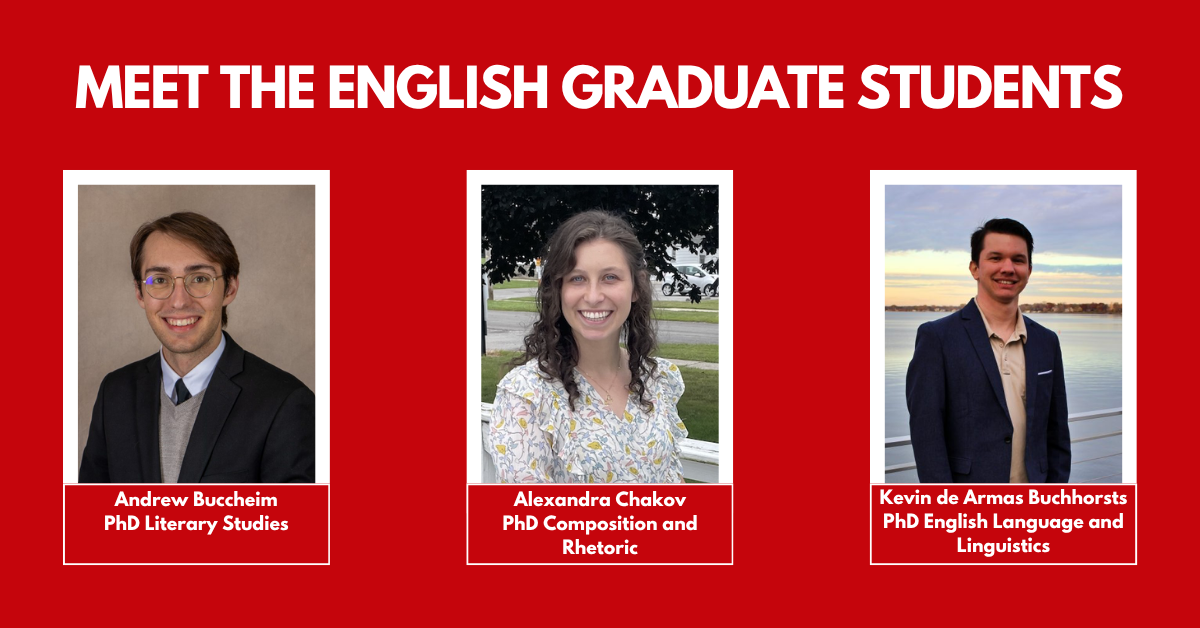
I selected three PhD students to interview that represent the three track areas available for the PhD degree to give undergraduate students a closer look at the ways in which pursuing a post graduate degree can be valuable. Andrew Buccheim is pursuing a PhD in the Literary Studies track, Alexandra Chakov is pursuing a PhD in Composition and Rhetoric track, and Kevin de Armas Buchhorsts is pursuing a PhD in the English Language and Linguistics track. Their dedication and hard work are immensely valuable, and I am very grateful to have had the opportunity to learn about their experiences.
1. Why did you decide to pursue this graduate program at UW? What is your degree path?
Andrew: I was originally interested in graduate study at UW because of the university’s reputation for research excellence and its strong tradition of Renaissance scholarship across all its humanities departments. I am currently a third-year in the Literary Studies PhD program, which is a 6-year degree path that involves taking graduate coursework, teaching, and writing a dissertation. This August, I will take preliminary exams for PhD candidacy, and after I complete those I will begin putting together my own dissertation.
Alexandra: I grew up in New Jersey, but attended undergrad at a small school in Ohio. I was an English major with a concentration in Writing at Heidelberg University. I then attended the University of Findlay for my Masters of Rhetoric and Writing. I am currently a PhD candidate here at UW–Madison in the Composition and Rhetoric program. I am on track to graduate next year and hope to obtain a job as a professor. When I was applying for PhD programs, I was looking for schools that had scholars I was interested in working with, that had funding support, and offered teaching and administrative opportunities. UW–Madison fit all of these categories.
Kevin: I decided to pursue the PhD in English Language and Linguistics at UW–Madison because, after completing my Master’s in Education at the University of Puerto Rico, I felt a strong desire to continue developing academically. During my MA, my interests shifted from pedagogy toward linguistics, and my supervising professor, Dr. Cristopher Font, who graduated from this same program, encouraged me to apply. UW–Madison was my first choice because of its excellent faculty, strong research environment, and overall academic reputation. I was fortunate that it was also the first program to accept me, coincidentally I got the good news on my birthday.
2. Why were you initially interested in pursuing this degree path? Has that initial interest changed or transformed during your time at UW?
Andrew: My undergraduate majors were English and Political Science, so I chose to pursue Literary Studies as a means of combining my commitment to a critical-theoretical approach to scholarship with my interests in early modern European history, culture, and literature. While research has always been a core part of my academic life, my passion for teaching is what led me to consider grad school in the first place. I’ve taught and TA’d for a few introductory courses in the department, and it’s been a real joy to work with and learn from our undergraduates. Being able to incorporate some piece of my own interests and research into teaching is always fulfilling, and it has been especially edifying to help students develop their own long-term research projects over the course of the semester English 100.
Alexandra: When I applied to graduate school for my master’s, I planned to use my degree to obtain a job in tech writing. I was given a TA position that first semester, so I was the Instructor of Record for a first-year writing course. As soon as those first 50 minutes were over, I knew I wanted to keep teaching and that my plans were going to change from a future in tech writing to a future of being a professor. Once I knew I loved teaching, I decided to pursue a PhD.
Kevin: Since coming to UW–Madison for my PhD, my goals haven’t changed too much. I still love teaching and want to be a professor. My experiences here at UW have broadened things for me though. My academic background had always centered on Teaching English as a Second Language, but it was not until I took linguistics courses during my Master’s that I realized how much more there was to explore about the structure and processing of language. My initial interest has not changed. Instead, it has broadened as my time at UW has expanded my understanding of the field and introduced me to a wide range of research opportunities I had not previously considered.
3. What is your research? How does your research fit into the broader field of your chosen graduate program?
Andrew: My research centers on the embodied experiences of literature enabled by early modern print. I study both literary and nonliterary texts from the early decades of print in England, and I am particularly interested in how authors of this period understand the mediated reception of ideas, information, and images as a directly transformative bodily experience. My approach is informed by media theory, book history, disability studies, and reception theory, and like many other scholars in Literary Studies, I am interested in how we use texts to understand or define notions of subjectivity, individuality, and the body. Period-wise, I fall firmly into the “early modern” camp, which roughly comprises the years between 1500 and 1800.
Alexandra: My research is focused on the relation of writing and memory, particularly in relation to Jewish rhetoric and Holocaust studies. I am currently writing my dissertation that explores the rhetorical future of Holocaust testimonies. In my project, I analyze museum material artifacts, the tattoos from Auschwitz, and post-Holocaust art using the rhetorical concepts chora and kairos to examine how these artifacts function testimonials and provide a future memory of the Holocaust. My graduate program is Composition and Rhetoric. My research sits in the rhetorical side of the field.
Kevin: My current research lies at the intersection of Second Language Acquisition, Psycholinguistics, and Computational Linguistics. My primary study examines the acceptability of specific sentence structures, particularly island effects, in English and Spanish across three groups: native English speakers, native Spanish speakers, and L1 English–L2 Spanish learners. I have also worked on projects involving Natural Language Processing, including the use of large language models for lexical and syntactic tasks. My research aligns well with the broader goals of the English Language and Linguistics program and also allows me to engage with computationally oriented coursework where I can contribute linguistic insight to interdisciplinary projects.
4. What made you interested in the research you’re currently pursuing?
Andrew: I have always had an interest in history and historical literature, but it wasn’t until my undergraduate years that I began to take that interest more seriously. In two literary survey courses early in my degree, I had a chance to write some longer, more involved research essays, one of which turned into a conference presentation and a published paper. This research was on race and disability in Shakespeare’s Othello, and the process of gaining expertise and developing my own, theoretically informed reading of the text left me wanting to know even more about early modern literature (including Shakespeare!) as well as disability studies. While my research has evolved as I’ve grown older and read more, I still find myself interested in the same sorts of questions and interpretive possibilities.
Alexandra: As a Jewish woman, I’ve always been interested in the Holocaust as it is a part of my community’s history. This interest slowly became a scholarly interest while I was pursuing my master’s degree. During the first year of my master’s program, I was taking an ancient rhetoric course and a lot of the examples my professor was giving us for final paper ideas were based in Christianity. This made me wonder what a Jewish rhetorical tradition was. I began looking into what Jewish rhetorical scholarship existed, which is when I began reading work by my current advisor. Around this time, I also found Cheryl Glenn’s work on the rhetoric of silence, which led me to think about the ways Holocaust survivors may or may not use silence to work through their trauma. Through these two paths, I eventually found my own footing within the subfield of Jewish rhetoric with a focus on the Holocaust.
Kevin: My research interests grew out of my personal and academic background. I was born and raised in Puerto Rico, where English and Spanish function side by side as official languages and studying in that environment made me curious about how bilingual speakers process and interpret different linguistic structures. This interest deepened during my Master’s program at the University of Puerto Rico, where I worked as a research assistant and helped develop a corpus with varied lexical and syntactic structures for a natural language parser. Since coming to UW–Madison, my coursework and lab involvement have continued to shape that curiosity and have encouraged me to explore new questions that build on, and extend beyond, my earlier work.
5. Are there any other ways in which you’re involved on campus?
Andrew: Aside from teaching English 100 and introductory literature classes, I also work as a project assistant, helping with faculty teaching during the academic year and research during the summer. I have presented my work and chaired a panel during previous years of the Graduate Early Modern Student Symposium. I have also volunteered with Holding History, a public humanities program at UW, for events at Memorial Library Special Collections, where I helped students and community members interact hands-on with rare books and other archival materials.
Alexandra: I am currently the co-President of the Rhetoric Society of America UW–Madison Student Chapter. We host a few professional development events a semester and host an annual spring symposium for people interested in the field of rhetoric!
Kevin: I am currently a member of the English Language and Linguistics Psycholinguistics Lab led by Dr. Juliet Huynh and the Second Language Acquisition Lab led by Dr. Jacee Cho. I also serve as an E100 Teaching Assistant, a Writing Center tutor and outreach facilitator, and the Vice President of the Applied Linguistics Student Association. Outside of academics, I am a member of the UW Table Tennis Club and Team.
Andrew, Alexandra, and Kevin are three students who demonstrate the undeniable diligence, passion, and enthusiasm of the greater population of UW’s English Graduate students. For such an esteemed program, it is no surprise that students and their work are immensely applaudable. As an undergraduate, it was inspiring to learn about the ways in which I can pursue my own academic passions, and I hope other undergraduates take the chance to learn about such too.