How to Sing the Elegies for the Season: Sarah Dimick’s Unseasonable
A Timely Debut Book by UW-English Alumni Sarah Dimick
by Shuta Kiba
The season is personal. Every seasonal change brings last year’s (or even decades of) memories back to us with the chirping of birds, the clouds in the sky, the humidity on our skin, or the smell in the air. The repetitive nature of the season gives us tangible forms we can inhabit to carry them forward, as habitual memory. At the same time, the season is a global phenomenon that is collectively shared as a common experience among a diverse population.
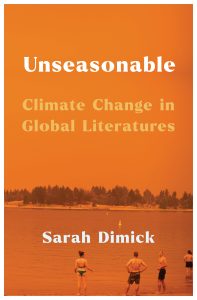
Sarah Dimick’s Unseasonable effectively and sensitively employs the multifaceted scale of the seasonal forms to articulate how the global effects of climate change on seasonal experience—the “unseasonable” phenomena—affect the personal and particular rhythms of everyday life. Seasonality allows her to zoom in on the particularity and differences, that is, the uneven distributions of climate change’s negative effect on certain populations, while also zooming out and discerning the startling connectivity, proximity, and echoes in diverse experiences.
Dimick’s writing—constant rhythms of the zooming-in and zooming-out—embodies the contraction and expansion, the “pulses” of the season; in so doing, Dimick carefully attends to what she calls “climate arrhythmias”: the ways climate change disrupts seasonal rhythms. As a result, her gaze always lingers on the ghostly presence of what has been lost in the season, making her tone inevitably elegiac (indeed, Dimick begins her book with Zadie Smith’s “Elegy for a Country’s Seasons”).
In his recent article “Elegies for the Planet,” Johan Ramazani notes that “anticipatory mourning for the slow, uneven, and uncertain climate-induced dying of human and other species (175)” often turns ecocritical poems and scholarship into elegies. Despite the accusation that eco-elegies are “othering” nature or accepting a defeatist position, Ramazani argues, they in fact foster connection and friendship with other species through grief, offering a narrative of conservationist survival: “They grieve defiantly, disruptively, ferociously” (203). Dimick’s repeated acknowledgment of arrhythmic loss is just such a defiant resistance to the normalization of loss: “There is meaning in repetition itself, in the persistence of seasonal practice even in the face of intensifying climate change. In this sense, to keep time is also to safeguard, protect, and defend” (223). Seasonal elegies embody the politics of survival.