Literature as Medicine: What Pre-Med Students Learn from Poetry
How Poetry Can Change the Future of Medicine
by Shuta Kiba
For many of the pre-med students in English 156: Literature and Medicine, Caroline Hensley’s class offers the first in-depth experience of learning the power of humanistic knowledge to reflect on, critique, and creatively engage with the history and culture of medicine. More than ever, there is an urgent need to promote the value of humanistic education and its direct and profound effects in the world. So, we interviewed Hensley about her course on what she calls “embodied writing,” including her thoughts on the humanities’ role in the education of pre-med students.
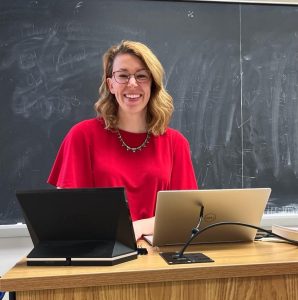
What was it like to teach future medical professionals how to read poetry? How does the English lit perspective come into play in the interdisciplinary nature of your class?
“I think I coaxed a number of them into loving poetry. They’re so afraid of poetry initially because of its unfamiliar, open-ended forms, and because many of them imagine themselves as seekers of ‘clear answers’ who are proficient in STEM and only STEM. But poetry like Leila Chatti’s collection on religion and reproductivity and Danez Smith’s ruminations on HIV diagnosis help them see poetic language and genre as alternate rallying cries for action around topics they already believe to be important, like environmental wellbeing and social determinants of health. It’s so eye-opening and exciting for them to experience firsthand. They already know the medical vocabulary of the body, but they didn’t know it could be explored through poetry. I would say they responded really, surprisingly well to the poetry.”
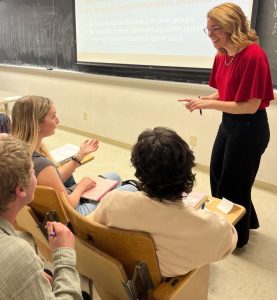
Can you give me an example from class?
“In one week, which I called “poetry of the body politic,” we read Adam Dickinson’s book Anatomic. Dickinson basically ordered a whole series of tests and experiments in which he took samples of his own stool, hair, skin, and saliva, then shipped them off to labs to determine what kinds of chemicals appeared in his body. He then transformed these test results into poetry as commentary on environmental pollution and consumption, envisioning his body as an ecosystem rather than an individual. Students found it fascinating how scientific test results and jargon could produce a poetic meditation on vulnerability.”
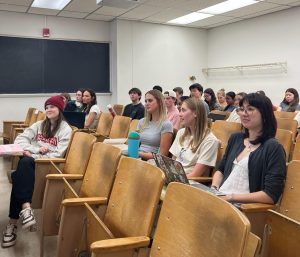
What are your students like?
“My students are almost entirely from fields outside of the Humanities, and many are on pre-med, pre-nursing, or social work tracks. So, they’re mostly students who imagine themselves in future positions of power and care provision. Many of them are also at the junior or senior level, some of whom are taking the MCAT or are already working in clinical environments as EMTs or certified nursing assistants; part of the beauty of a class like English 156 is that it gives them an outlet for reflecting on experiences that they’re currently having and that will continue to shape their career trajectories. I should also say that these students are empathetic, curious, hardworking, kind, and despite their protestations, highly creative.”
What kind of projects do students conduct to learn about medicine from the humanities perspective?
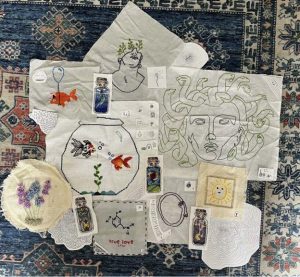
“The introductory assignment was a project I called ‘literary prescriptions.’ I first tweaked a template of a real medical prescription form and then asked students to select a piece of media that they wanted to prescribe to someone in need of relief or healing from an ailment. And they did some really clever things! They interpreted words that normally have such specific clinical meanings, like dosage, strength, application instructions, storage and handling, ingredients, adverse side effects, etc., through humanistic lenses, and prescribed their chosen media piece as a form of medicine. For instance, many students prescribed books to patients and described their ingredients as high fantasy, comedy, plot twists, or deep reflection on illness. The adverse side effects category turned out really creative, too—listening to a pop culture song will result in an awesome summer or inspire you to go gallivanting in the woods, etc. So, they got to reinterpret what is normally very clinical language and genre through a more creative lens to suggest that literature, literary objects, and other kinds of media can have a real healing impact. For some students, the act of completing this project made them realize that healing takes different forms and that stories or art can serve as remedy in ways comparable to medications.”
Finally, what kind of knowledge and skills would you like your students to learn from this class?
“This might sound basic, but generating sustained empathy is what I think so much of literary studies is for. Especially for students who will occupy positions of power within healthcare, I think perspective shifts are exceptionally important. I also want them to feel empowered to write without having to care as much about how polished their writing feels. I aim for them to make a habit of writing and communicating ideas to others and witnessing without judgment. Given that burnout is really high in the medical field, the habits of writing and reflection will serve them well dealing with a stressful profession marked by uncertainty and high stakes. The last thing I would add is that I hope they develop the ability to connect particular patient experiences to larger structural and political issues. In medical settings, they might welcome individual narratives tenderly and use these stories as a way to sense patterns about how health tethers us all.”
English 156 is one of the core courses for the Health and the Humanities certificate, an interdisciplinary certificate popular among pre-med students. For more info, click here.