Flamingos in Folklore and Literature – The history of Madison’s home bird in the human mind
Flamingos in history, popular culture, and Madison.
by Evan J. Randle
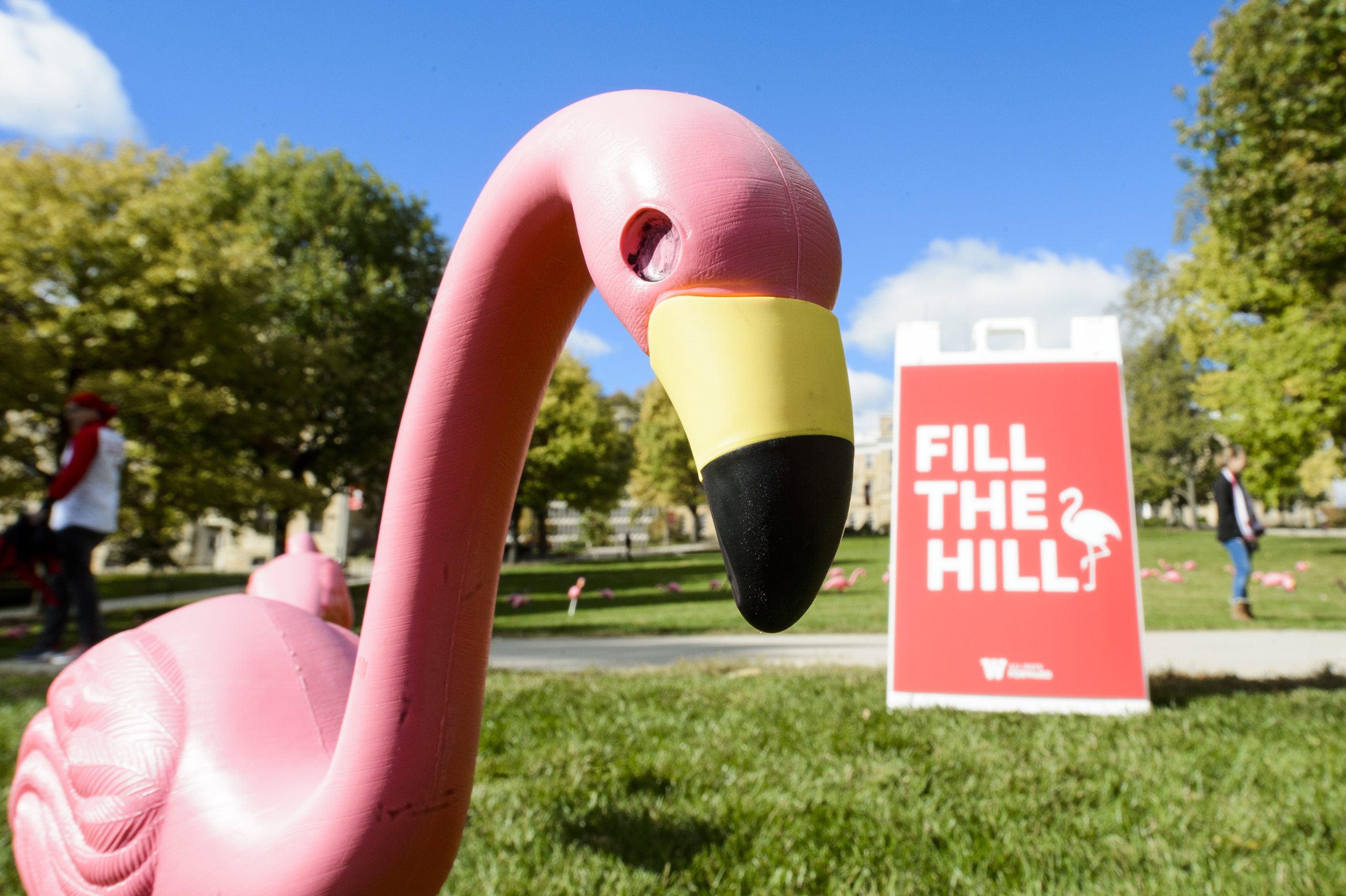
This year’s ’fill the hill’ is almost upon us. Celebrating a famous prank, the annual fundraising event is perhaps best known for one novel sight:
Lawn flamingos claiming Bascom Hill as their territory, standing tall and proud as the statue of Abraham Lincoln looks over them with pride.
Flamingos, outside of their association with this delightful prank, are well-regarded as beautiful and bright-pink birds. But what have they represented in folklore and literature in history?
Found on both sides of the globe, the flamingos were revered by the ancient Egyptians as a form of the sun god Ra, while the Greeks considered them the blush-colored icons of life, death, rebirth, and transformation. They also appear in ancient paintings found in Libya, Israel, and Turkey. Their bones were even used as musical instruments by some cultures.
What about more recent literature? Here flamingos continue to appear. Perhaps their most noteworthy outing of the past few centuries is in Lewis Carroll’s Alice’s Adventures in Wonderland, in which they are substituted for croquet mallets. When Alice attempts to use one in the game, it repeatedly amuses her but serves little use. Though not necessarily plot-relevant, the flamingo-mallets are one of the most memorable examples of Carroll’s surrealist writing.
Acclaimed Austrian poet and novelist Rainer Maria Wilke wrote a poem titled Die Flamingos (The Flamingos in English). In this piece, flamingos are seductive creatures, ones that instill deep jealousy in other birds despite their less-ostentatious insides. They ultimately “stride, alone, into the world of dream.”
Flamingos have remained relevant in modern popular culture, whether through the form of an award-winning statue at the Tampa airport, a verse of a Lana Del Rey song, or more abstractly representing American optimism and/or gender ideology.
So is there any clear consensus on what flamingos represent in culture and literature? Not precisely. Across history and in different forms, the pink avians have represented the cycles of life, surrealism, objects of jealousy, and more. At UW–Madison specifically, flamingos embody the energetic creativity of the student body while encouraging the greater community to support the university and its divisions.
For all we know, another student of UW–Madison – perhaps one in the English department – will unearth a new meaning of the beautiful avians.